Loading...
Older Salinas commercial buildings lose money through under-insulated walls and ceilings every day. We install insulation that holds temperature, reduces your PG&E bill, and meets California's building standards.
Commercial insulation in Salinas slows heat movement through your building's walls, roof, and floors, keeping your space at a consistent temperature and your HVAC system from running constantly - most straightforward jobs finish within one to three days with no need to close your doors.
A large share of Salinas's commercial buildings, particularly in the downtown corridor and older agricultural-support districts, were built before California's current energy standards took effect. If your building went up before the mid-1990s, there is a reasonable chance it is losing energy through walls and ceilings that could be fixed for a predictable cost. The fix is not complicated: a contractor assesses what is there, seals air gaps, and installs material rated for your building type and climate zone.
For buildings where temperature control is critical, such as cold storage or processing facilities in Salinas's agricultural sector, the stakes go beyond comfort and energy bills. For those properties, proper insulation is a product-quality and compliance issue. Whether you run a small retail space near downtown or a facility connected to the Salinas Valley's food supply chain, spray foam insulation and other commercial-grade materials offer the performance your building requires.
These are the clearest signs that your building is losing money through insulation gaps.
If your energy bill has gone up noticeably without adding equipment, extending hours, or changing how you use the space, poor insulation is one of the most common causes. Heat and cold moving freely through walls forces your HVAC to work harder and run longer than it should.
If one part of your building is always uncomfortable, stuffy in summer or drafty in cooler months, that is often a sign that insulation is missing or inconsistent. In Salinas, this is frequent in buildings with metal roofs or older flat-roof construction where insulation was minimal from the start.
Salinas's cool, foggy mornings create conditions where moisture forms on surfaces inside a building when warm interior air meets a cold, poorly insulated wall or ceiling. Water droplets, damp patches, or early mold signs near exterior walls are signals that your building envelope is not managing moisture properly.
Any time a contractor cuts into walls, opens up a ceiling, or works around pipes, there is a chance insulation gets moved or left out when things are put back together. If your building has had significant work done and nobody specifically addressed the insulation afterward, it is worth having someone take a look.
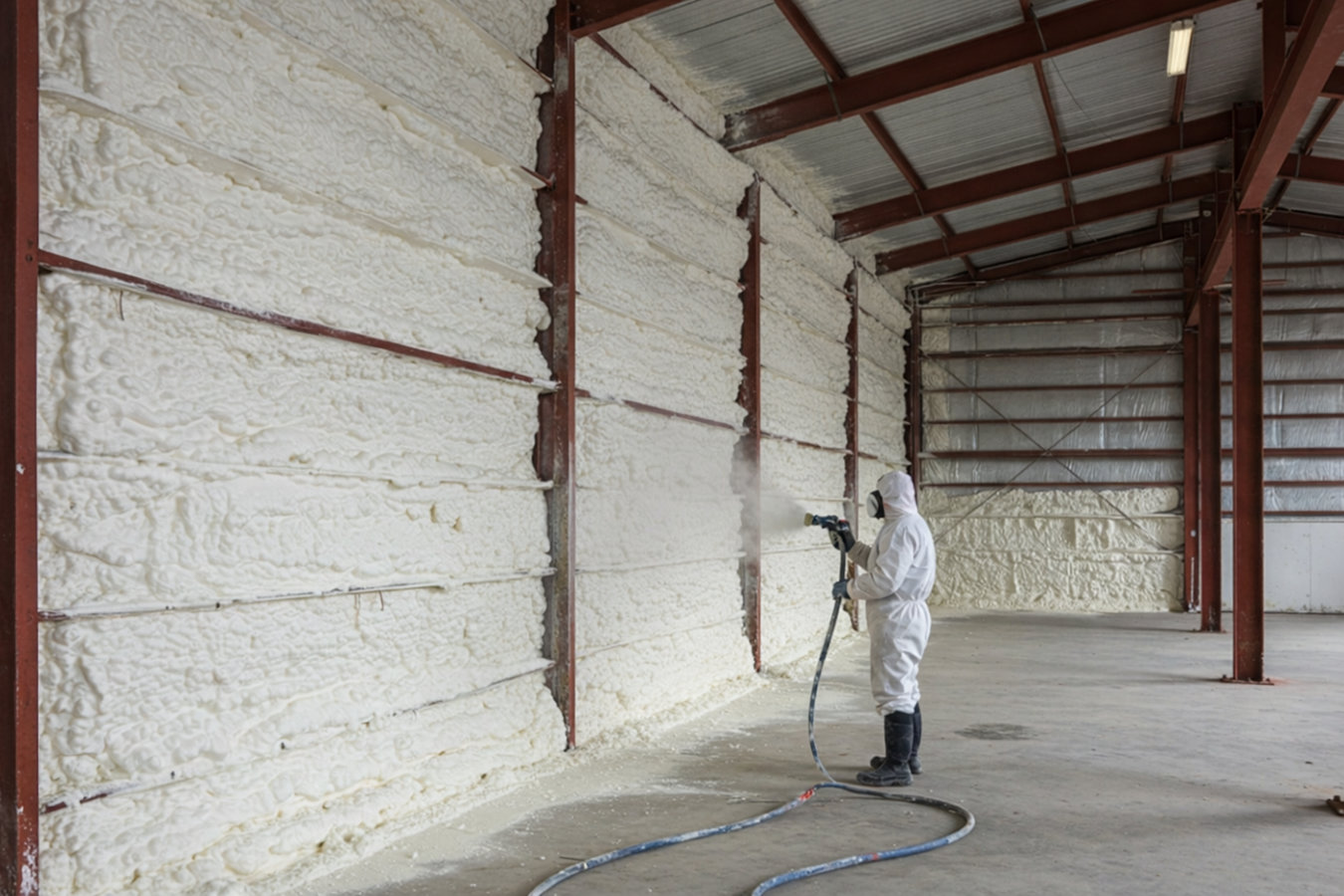
Most commercial buildings use one of three main insulation types depending on where the material goes and what it needs to do. Spray foam is the most versatile option for commercial work: it seals air gaps and insulates in one step, making it effective around mechanical spaces, pipe penetrations, and hard-to-reach areas. It is the right choice when the building envelope has a lot of irregular geometry or when temperature control needs to be very tight. For buildings in Salinas's agricultural sector, such as cold storage and packing facilities, spray foam paired with rigid board panels provides the continuous thermal barrier those environments require.
Blown-in loose-fill is the practical choice for open attic spaces and for bringing existing insulation up to current depth requirements. It is fast to install, consistent, and effective for the mild but variable Salinas climate. For new construction or renovation projects involving open wall cavities, batt insulation can be installed before drywall goes up. Every project, regardless of material, includes an air-sealing pass first. Gaps around pipes, wiring, and framing let conditioned air escape freely and can cancel out much of the insulation's benefit if left unsealed.
If your walls need attention alongside your roof or attic, wall insulation can be coordinated into the same project scope to minimize the time your operations are disrupted. We also handle the permit process and PG&E rebate documentation so that side of the project does not fall on you.
Best for irregular spaces, penetrations, and facilities where tight temperature control is critical, including Salinas agricultural buildings.
Fast, consistent, and cost-effective for bringing open commercial attic spaces up to current California energy standards.
Used in flat-roof and continuous insulation applications where consistent R-value across the entire surface is required.
Included on every commercial job; closing gaps before adding material is what makes the energy performance hold in Salinas's breezy climate.
Specialized work for Salinas Valley food-handling and cold storage facilities where temperature compliance affects product quality.
We manage California Title 24 documentation and PG&E commercial rebate applications so the administrative side of the project stays off your plate.
Salinas sits at the northern end of the Salinas Valley, where Monterey Bay's marine layer keeps mornings cool and damp well into summer. Commercial buildings here do not face the extreme heat that drives insulation decisions in the Central Valley, but they face a different challenge: persistent moisture in the air that can work its way into poorly sealed walls and ceilings over time. The National Weather Service documents Salinas's climate patterns, which show consistently higher relative humidity than inland California cities, particularly in mornings and evenings.
The city's commercial building stock reflects its agricultural history. Many of the older structures in the downtown corridor and the industrial areas near the valley floor were built for function, not energy efficiency, and their insulation has often never been updated or was minimal to begin with. California's commercial energy standards now require a meaningful level of insulation performance in any renovation or change-of-use project, and older buildings rarely meet those thresholds without targeted upgrades.
We serve commercial clients throughout Salinas and the surrounding area, including businesses in Monterey, Seaside, and as far as Santa Clara. Whatever your building type, we bring the same approach: assess the actual condition, seal before filling, and install material suited to this specific coastal climate.
We reply to all inquiries within 1 business day. Here is the process from first contact to project closeout.
Tell us the size of your building, how it is used, and what problems you are noticing. We ask a few questions to figure out what to look for on-site. You do not need to have all the answers.
We walk your building, check the attic or roof space, look at walls and mechanical areas, and note where insulation is missing, thin, or damaged. This visit usually takes one to two hours and results in a written scope of work, not just a verbal estimate.
You receive a written quote covering scope, materials, and cost. If your project requires a permit, we explain that upfront, including who pulls it and how it affects the timeline. We also walk you through any applicable PG&E rebates before you sign anything.
The crew sets up, protects surfaces as needed, and installs to the agreed scope. Before closing out the job, we walk you through the completed work and provide all documentation needed for permit sign-off or a PG&E rebate application.
Free on-site estimate. No obligation. We reply within 1 business day.
(831) 243-7355Cold storage, packing sheds, and processing facilities in the Salinas Valley have insulation needs that differ from a typical retail or office space. We have worked on agricultural buildings in this market and understand the temperature control and compliance requirements that come with them. The Monterey County Agricultural Commissioner oversees many of the compliance requirements for food-handling facilities in this area.
California enforces detailed building energy standards for commercial work, and renovation projects in Salinas must meet them. We know what triggers a permit requirement, pull the right permits, and document the work correctly so you are not exposed to compliance issues during a future inspection or sale.
PG&E offers real rebate money for commercial insulation upgrades, and we handle the documentation process. Most business owners do not have time to manage a utility rebate application on top of a construction project. We ensure the paperwork is done right so you capture the full value of the project.
Our crews have years of experience with commercial insulation across the Salinas Valley, from ag facilities to office and retail space. We put the full scope and cost in writing before we start and document the finished work with photos, so you have a clear record for future inspections or a sale.
Commercial insulation work in Salinas requires someone who understands the local climate, the building stock, and California's regulatory requirements. We bring all three to every project and handle the parts that should not fall on your shoulders.
Spray foam is the go-to material for commercial spaces where air sealing and insulation performance need to work together in one application.
Learn moreExterior and interior wall insulation for commercial buildings, including dense-pack methods for walls that cannot be opened from the inside.
Learn morePG&E rebates are available now for qualifying commercial upgrades. Call or submit the form and we will schedule a site visit within 1 business day.